Step-and-a-Half
The Master Butchers Singing ClubStep-and-a-Half is an itinerant rag picker whose long stride and guarded manner make her seem at once formidable and elusive. Her defining act is revealed only late: more than forty years before the recollection, she rescued the newborn Delphine from an outdoor privy and placed her in Roy Watzka’s care. She never becomes a conventional mother or settles into domestic life, yet she returns to Delphine repeatedly, offering money, attention, and practical gifts. The gap between her restless wandering and this durable attachment gives her character its force: she cannot remain, but neither can she wholly leave.
Identity and Life on the Road
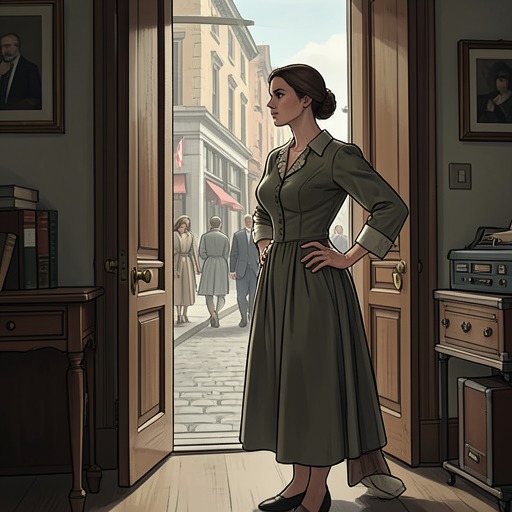
When Delphine encounters her at the butcher shop, Step-and-a-Half is described as a rangy woman who appears to be between thirty and forty, with an air of ancient bitterness. Her name comes from the phenomenal length of her stride. She lives alone when she is in Argus at all, earns her living trading in rags, and is known to walk the streets at night, checking back porches for discarded clothing. The motion is more than a means of work: before settling in Argus, she walked the long roads of North Dakota, sleeping in ditches, among riverside trees, and in the occasional barn or porch. She cannot say how far she travelled. Her life has been organized around keeping moving.
Her livelihood makes her both scavenger and observer of the town’s overlooked material life. She gathers worn skirts, shirts, blouses, coats, and other leavings, and she also eats what the butcher shop can spare. On Delphine’s second day at work, she comes in during a furious jangling of the bell for tripe, snouts, or bones. Eva has set aside bones cut generously and still hung with scraps of meat. Delphine wraps them in white paper and string, but Step-and-a-Half unwraps the parcel and studies the fat-smeared bones as if they might tell the future. She tells Delphine to give them to Eva instead. The moment turns a routine exchange into an encounter with her hard-to-read standards: she will accept what she needs, but not passively, and she does not treat the shop’s scraps as interchangeable charity.
The butcher shop serves a broad economy of need. Its food reaches the banker who receives a perfect steak, customers who buy sausages or cheap cuts, a Dakota Sioux family trading wild meat or berries for flour and tea, and people who cannot pay, including Step-and-a-Half, the Shimeks, Simpy Benson, and unemployed fathers travelling the Depression roads. The remains continue down the chain: dogs gnaw bones she rejects, and plants grow from what even the dogs cannot chew. Step-and-a-Half belongs to this world of exchange and leftovers, but she is not merely a passive recipient. Her established trade and knowledge of who will admit her through a back door make her a working intermediary between discarded goods and the people who need them.
The Rescue and Delphine’s Childhood
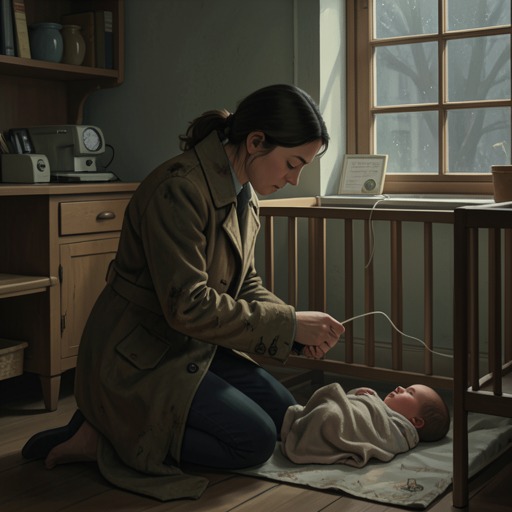
The novel’s late recollection explains the private history beneath Step-and-a-Half’s wary relationship with Delphine. More than forty years earlier, she came upon the newborn in an outdoor privy after hearing a cry through the walls. She waited, then heard it several more times, each cry more animal in its intensity, until she became certain that someone needed help. When Mrs. Shimek emerged from the privy, Step-and-a-Half went in. She freed the baby, cleared its mouth with a finger, puffed air into its face, and pressed the convulsed child against her own body beneath the layers of clothing she wore. The rescue is described as a narrow escape: she later thinks of the small margin by which Delphine survived, and of the dirty fates the girl would evade as she grew.
Step-and-a-Half took the baby to a temporary den near the edge of Argus, where Roy, then a bachelor farmer, was living. Roy had fallen in love with Step-and-a-Half and proposed marriage, offering a future of a milk cow, a golden ring, a wagon and horse, a chicken coop, and even a hand organ to play on winter nights. The condition was that she stop wandering and settle down with him. She knew she would leave the baby with Roy, and she did; she did not accept the settled life he imagined for her. The baby’s ragged cry as she carried it away sharpened the contradiction in the choice: Step-and-a-Half could save Delphine and entrust her to someone who would raise her, but she could not make herself stay.
Her departure did not end her involvement. She had not foreseen that she would feel compelled to return again and again, give Roy money to keep the child secure, and try in small, clumsy ways to tend the growing girl. The narrative supplies no simple declaration of maternal identity in place of these actions. Instead, their bond surfaces in gestures and in memory. Once, when Delphine was little, she followed Step-and-a-Half and called her “Mama?” Step-and-a-Half stopped and knelt to look at her. She told the child that her mother was dead; Delphine’s face closed, then steadied, and she struck Step-and-a-Half on the forehead with her fist. The adult woman’s recollection holds tenderness and fear together: she remembers the child’s bold, survivor’s eyes, and the force with which Delphine answered a truth she was too young to understand fully.
Gifts, Work, and Friction
In the present-day household, Step-and-a-Half’s connection to Delphine remains indirect and sometimes abrasive. Eva treats Step-and-a-Half, like the shop’s other outsiders, with consideration. Her care for a dog—scratching the places it cannot reach and brushing out its matted fur—helps Delphine recognize Eva’s unusual sensitivity to animals and people treated as odd or marginal. Delphine loves Eva all the more for this generous regard, which includes Step-and-a-Half without requiring her to become less peculiar or more sociable.
After Eva’s death, Step-and-a-Half gives Delphine a fancy tasseled lamp, apparently in a fit of bewilderment. Delphine later places it in her quiet room, where its pinkish light falls on pale-gold walls and framed forest pictures. The gift becomes part of an interior refuge Delphine has made from repaired furniture, borrowed and salvaged things, reading, and tea. Its inexplicable arrival carries the same pattern as Step-and-a-Half’s other acts of care: she does not explain herself, but a material object remains where affection might otherwise go unspoken.
The two women’s differences become sharper when Roy begins helping Step-and-a-Half sort and haul the town’s leavings. He works at the shop for ten cents and a slice of sausage, then joins her in gathering scraps from porches. They make a conspicuous pair: she is tall and proud among her collected skins and rags; he is stooped, pale, and visibly marked by drinking. Roy builds them a light cart from broken crates, bent hardware, and bicycle tires. Step-and-a-Half’s long-established relationships with the cooks and back doors of wealthy households give Roy access to places he could not easily approach alone. Delphine is glad that her father has taken up honest work, but she resents the attention his partnership with such an unusual woman brings. She also suspects that Step-and-a-Half dislikes her because Delphine seems to have taken Eva’s place behind the counter.
Step-and-a-Half’s judgments of Roy and Delphine are blunt. When Delphine comes to her shop hoping to take over Tante’s former job, Step-and-a-Half asks why people from the butcher shop keep coming to her and says she gave Tante work out of pity. She tells Delphine that she does not need the job and should leave Roy to his drinking, adding that the whole town feels sorry for her. She has recently turned Roy away from her own shop when he arrived soaked. The exchange makes their concern difficult to separate from insult: Step-and-a-Half sees the danger in Delphine’s continuing responsibility for her father, but expresses that recognition in a manner that offers no comfort and little deference.
Care Through Things and Changing Circumstances
Step-and-a-Half’s care often takes the form of food, tools, clothing, or work rather than reassurance. She collects a set of pots and pans and a good carving knife left on a porch, cleans and keeps the knife, and evaluates the remaining objects by testing their handles and weighing them. Among the bolts of calico, broadcloth, and wool, she chooses fabric for someone she believes deserves a present. She cuts a length of dress material and assembles colored thread, possible buttons, and ribbons for a girl’s hair, packing the set in brown paper and string. Irritated with herself for not thinking of it the day before, she sets out in daylight with the bundle under her arm, deprived of the cover and comfort of her preferred night-time errands. The preparation is meticulous, but the gift’s recipient and its delivery are not specified in the surviving account; the scene establishes her impulse to provide, not a completed exchange.
Later, when Step-and-a-Half enters the butcher shop for her usual pan of scraps, Fidelis has just dumped the scraps outside to lure dogs. Delphine looks through the glass at the shop’s perfect, expensive cuts, chooses a piece of beefsteak, and wraps it for her without explanation. Step-and-a-Half responds by telling her to keep the change, insulted, then leaves muttering about the high price of things. The moment reverses their earlier positions: the woman who once came for what others discarded now receives a choice cut from Delphine. Yet neither makes the exchange emotionally explicit. Delphine gives; Step-and-a-Half protests the price, preserving her pride even as the gesture passes between them.
The reversal sits alongside continuing practical cooperation. When Tante is searching for work, she is sent behind a muslin curtain and Step-and-a-Half appears from the other side, an unexpected possibility that brings Tante into her orbit. The prospect of working for the junk picker initially barely registers beside Tante’s fascination with a gleaming sewing machine, which seems to narrow her whole room to its shining needle and chrome flywheel. Step-and-a-Half’s business is thus not only a store of salvaged objects; it can also offer work to people pressed by circumstance. Her own shop spills into the street with butter churns, washtubs, an iron mangle, chipped jars, pots, rakes, hoes, and brooms. The clutter is meant to attract customers but can instead trip them or push them into the road, making visible the awkward boundary between useful salvage and obstruction.
Memory, Age, and Narrative Significance
In old age, Step-and-a-Half becomes beautiful in a stark, weathered way: the symmetry of her face emerges, her teeth remain sturdy, her hands and limbs appear graceful, and her hair turns an unusually pure white, rising in two waves from her forehead. Age, ownership of her junk store, and the insomnia that still plagues her leave her more often in reflection than the motion that once protected her from it. The narrative does not present this change as a conversion from wandering to settled domesticity. Rather, time forces into consciousness a history she had long carried through movement: the rescue, the child entrusted to Roy, and the consequences she watched unfold.
Her memories make clear that the apparent distance between rescuer and child concealed a continuing attachment, but they do not erase the distance itself. Step-and-a-Half gives Delphine a chance at life and keeps returning, yet remains unable to promise a permanent home or a conventional maternal role. The novel’s attention to her is consequently double: her choices preserve freedom, and that freedom leaves others to live with uncertainty. Her care is real precisely in its forms of return—money, food, clothing, a lamp, work, and remembered attention—rather than in a settled identity she never claims.
At the close of her recollection, Step-and-a-Half hums in her sleep, sinking into a tune assembled from scraps: courting verses, hunters’ wisdom, itinerants’ sayings, and words drawn from grass, cloud, or a pig’s knuckle. The image echoes her trade without reducing her to it. As she gathers fragments from porches and streets, so the song gathers fragments of other people’s language and experience; no single note is lost, and no song is wholly original. Her life, too, is made of salvaged continuities: a rescued child, repeated departures and returns, and care that survives without ever becoming stillness.